Richard Wilkerson
“Questa esecuzione non è giustizia. È un atto di vendetta.”
La scheda ufficiale
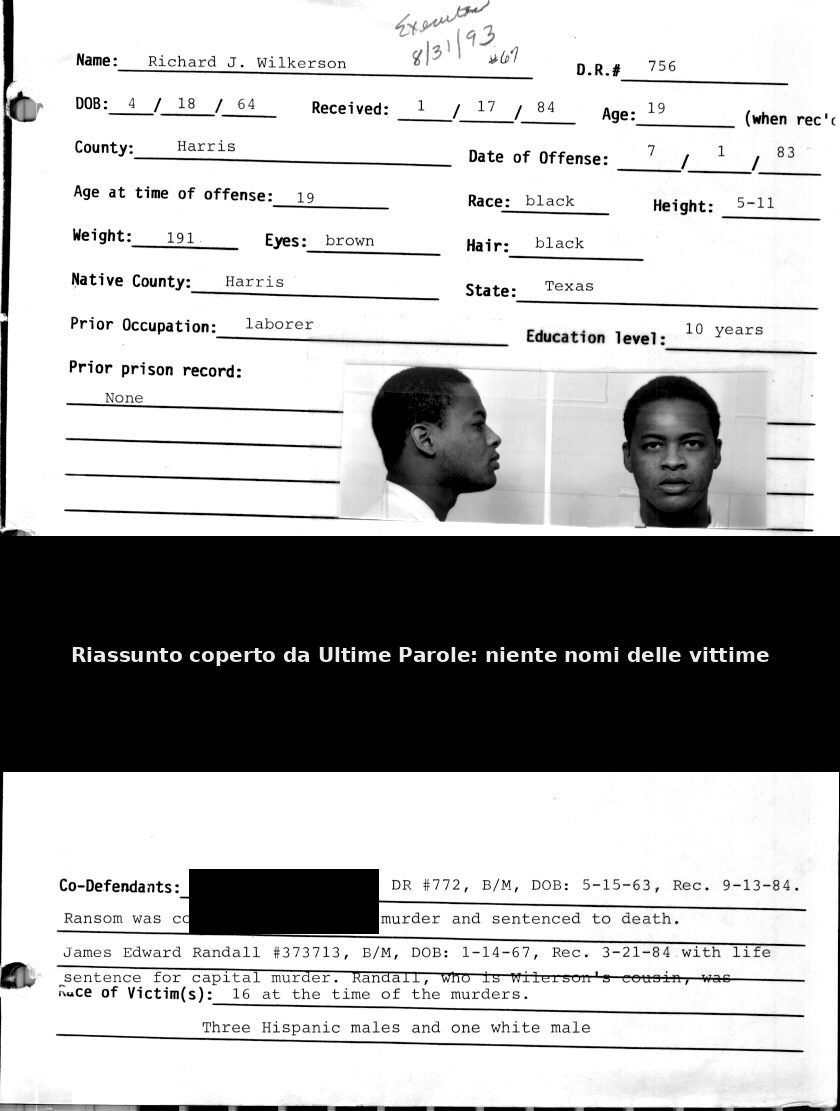
Scansione della scheda del Texas Department of Criminal Justice. Il riassunto originale contiene i nomi delle vittime: lo abbiamo coperto.
Il caso
Richard Wilkerson lavora ai box di una pista, in un centro divertimenti.
Lo licenziano.
Due settimane dopo, il centro viene rapinato. Il bottino: circa 2.000 dollari.
Il responsabile del turno di notte ha 18 anni. Studia per diventare medico.
Muore accoltellato con tre colleghi, di 22, 19 e 18 anni.
Due di loro sono fratelli.
10 anni dopo. Huntsville.
Richard Wilkerson ha 29 anni. È legato al lettino.
Il direttore gli chiede se ha un'ultima dichiarazione.
Fu giustiziato a 29 anni, dieci anni dopo il reato del luglio 1983.
Le sue ultime parole
Questa esecuzione non è giustizia. È un atto di vendetta.
Se questa è giustizia, allora la giustizia è cieca. Prendete un ragazzo al limite del ritardo mentale, che per la prima volta nella vita commette un reato grave. Inquinate la sua confessione, sincera e completa, aggiungete un giudice che discrimina e una giuria tutta bianca. Metteteci una difesa inefficace, giustiziate la possibilità di recupero, perseguitate i testimoni: avete creato una condanna a morte per una famiglia, durata più di dieci anni.
Lo ripeto ancora una volta: questa esecuzione non è giustizia, ma un atto di vendetta. Uccidere R.J. non riporterà indietro la vittima. Giustifica soltanto l'occhio per occhio, dente per dente.
Per aiutare R.J. è troppo tardi, ma forse questa poesia aiuterà qualcun altro, là fuori. Si intitola: Vedere con gli occhi di un condannato a morte.
A volte mi chiedo perché, perché proprio lui? Perché è andato nel mondo a vedere, a stare là fuori e vedere cosa c'era davvero? Ora il suo nome è scritto nella lista del braccio della morte. Posso solo immaginare quanto si sentisse solo. Sapevamo tutti e due che non aveva più un futuro. Le sue speranze e i suoi sogni sono diventati un'illusione. Diceva spesso: di me non è rimasto niente.
Mi sono chiesto perché si è messo con la droga. Non ha mai saputo spiegare perché frequentasse dei delinquenti. Lo faceva sentire un re? Pensava davvero di poterla fare franca con qualsiasi cosa?
Sapeva che in testa non aveva alcun pensiero per la vita. Non resta altro che il ricordo di chi è morto. Quel che è fatto non si può cancellare. Ha confessato: era uno dei colpevoli.
Cosa direbbe alla famiglia della vittima? Mi dispiace, non ero in me. Spero che accettiate le mie scuse, anche se è troppo tardi.
Non avrei mai pensato di togliere una vita e commettere un crimine. Me ne pento, perché ora devo affrontare l'iniezione letale nel braccio della morte. Sapevo che avrei pagato con fatica e dolore, ma non avrei mai pensato che il prezzo sarebbe stata la mia vita. Richard J. Wilkerson. Scritto tramite sua sorella Michelle.
Il testo originale
This execution is not justice. This execution is an act of revenge! If this is justice, then justice is blind. Take a borderline retarded young male who for the 1st time ever in his life committed a felony then contaminate his TRUE tell all confession add a judge who discriminates plus an ALL-WHITE JURY pile on an ineffective assistance of counsel and execute the option of rehabilitation persecute the witnesses and you have created a death sentence for a family lasting over 10 years. I will say once again… This execution isn't justice — but an act of revenge. Killing [...] will not bring [...] back, it only justifies "an eye for an eye and a tooth for a tooth." It's too late to help [...], but maybe this poem will help someone else out there. "Seeing Through the Eyes of a Death Row Inmate" Sometime I wonder why, why he? Why did he go out into the world to see? To be out there and see what really did exist, now his name is written down on the Death Row list. I can only imagine how lonesome he was all by himself. We both knew he had no future left! His hopes and dreams became a fantasy. He often said, "There's nothing left of me." I have asked myself, why did he get involved with drugs? He could never explain why he hung around with thugs? Did it really make him feel like a king — Did he actually think he was capable of getting away with anything? He knew the thought of life wasn't ticking in his head. There's nothing left but the memory of those who lay dead. What was did, cannot be undone. He was confessed, he was one of the guilty ones. What would he say to the victim's family? — I'm sorry and my head wasn't on straight. I hope you will accept my apology, even though it's too late. I never knew I would take a life and commit a crime. I regret it because now I have to face the lethal injection while doing death row time. I knew I would pay with struggle and strife, but I never thought the cost would be me losing my life. [...] Written through his sister [...]
I nomi di persona sono sostituiti da [...].
Il video
La domanda
Accusa lo Stato di vendetta, poi chiede scusa: le due cose possono stare insieme?
Rispondi nei commenti del video su Facebook, Instagram o YouTube.
Per approfondire
«A sangue freddo» di Truman Capote, il classico su un omicidio vero e un'esecuzione.
